How De-Vigging Works — Find True Odds Behind the Margin
· WildlyPlay
Every time you place a bet, the bookmaker takes a cut. It's baked into the odds before you even open the market. That cut is called the vig — short for vigorish. You'll also hear it called the margin, juice, or overround. Whatever you call it, it's the reason why sportsbooks are profitable businesses and most bettors aren't.
Understanding how to remove it — to de-vig — is one of the most fundamental skills in +EV betting. Here's exactly how it works.
What Is the Vig?
In a fair coin flip, both outcomes have a 50% probability. A fair price for each side would be 2.00 decimal odds (or +100 American). If you bet £100, you win £100.
But a bookmaker won't price it at 2.00/2.00. They'll price it at something like 1.91/1.91. Now implied probability on each side is:
1 / 1.91 = 52.36%
52.36% + 52.36% = 104.72%
That extra 4.72% above 100% is the vig. The book has created a market that totals more than 100% — ensuring a theoretical profit regardless of outcome.
The vig inflates the implied probabilities, making each side look more likely than it actually is. De-vigging is the process of stripping out that inflation to recover the true probabilities the market implies.
Calculating Implied Probability
Before you can de-vig, you need to convert odds to implied probabilities:
- Decimal:
1 / decimal_odds - American (positive):
100 / (american_odds + 100) - American (negative):
|american_odds| / (|american_odds| + 100)
Example: A match is priced at 2.40 / 3.20 / 2.90 (Home / Draw / Away, decimal).
Home:  1 / 2.40 = 41.67%
Draw:  1 / 3.20 = 31.25%
Away:  1 / 2.90 = 34.48%
Total: 107.40%
The vig here is 7.4%. The true probabilities must sum to 100%, not 107.4%. De-vigging finds what those true probabilities are.
The Four De-Vig Methods
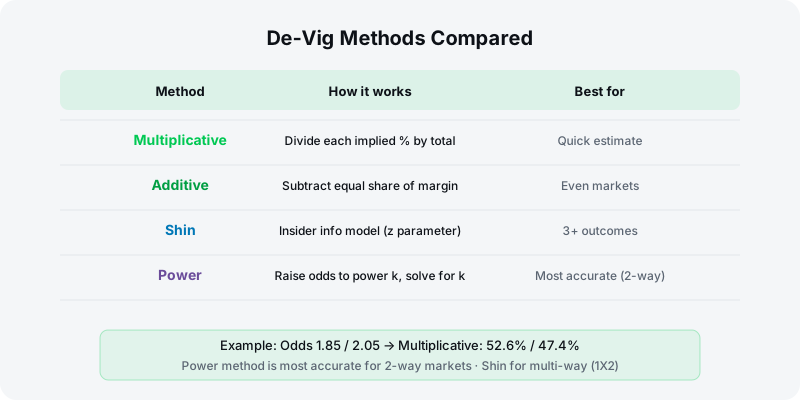
1. Multiplicative (Most Common)
Divide each implied probability by the total overround. Assumes the margin is distributed proportionally across all outcomes — larger probability outcomes absorb more of the vig.
Total: 107.40%
Home:  41.67% / 1.074 = 38.80%
Draw:  31.25% / 1.074 = 29.10%
Away:  34.48% / 1.074 = 32.10%
Sum:   100.00%
This is the default in most de-vig calculators. It's simple, intuitive, and works well for balanced markets.
2. Additive
Subtract an equal share of the margin from each outcome. The excess is 7.4%, split equally across 3 outcomes = 2.47% per outcome.
Home:  41.67% - 2.47% = 39.20%
Draw:  31.25% - 2.47% = 28.78%
Away:  34.48% - 2.47% = 32.01%
Sum:   99.99% (rounding)
Additive makes the most sense when you believe the book applies a flat fee regardless of how likely an outcome is. In practice, this slightly overweights underdogs compared to multiplicative.
3. Shin Method
Developed by economist Hyun Song Shin, this method assumes some vig exists because informed bettors (insiders) drive prices. The book widens margins partly to protect against sharp money, and that protection is not spread equally — it's concentrated on shorter-priced outcomes.
The Shin method solves for a parameter z (the proportion of bets by insiders) such that the adjusted probabilities reflect this asymmetric protection. The key output: favourites get slightly lower true probability than multiplicative suggests, underdogs get slightly higher.
For most punters, the practical difference is small. Shin matters most when you're specifically analysing markets you suspect have significant insider activity — certain horse racing markets, for example.
4. Power Method
This method finds an exponent k such that when you raise each implied probability to the power of k, they sum to exactly 1.00.
p_home^k + p_draw^k + p_away^k = 1
Solve for k numerically (binary search works fine). Then your de-vigged probabilities are each implied_prob^k.
The power method is philosophically elegant — it applies a single scaling factor consistently without assuming anything about the structure of the vig. It tends to produce results between additive and multiplicative, and performs well across markets of different sizes.
When to Use Which Method
| Method | Best For |
|---|---|
| Multiplicative | General use, most markets, quick estimates |
| Additive | When you think the book charges flat regardless of outcome |
| Shin | Markets with suspected sharp/insider action |
| Power | When you want the most mathematically neutral assumption |
For everyday +EV analysis, multiplicative is the industry default and perfectly adequate. Don't overthink the method choice — the bigger variable is the quality of the odds themselves.
Why De-Vigging Matters for +EV Betting
Positive expected value betting means finding odds where the true probability x payout > 1. But if you're using the raw bookmaker odds to estimate true probability, you're already starting corrupted — those odds include the vig.
De-vigging gives you a cleaner estimate of what the market collectively believes the true probability is. From there, you can compare that against your own model or line shopping across books. If Book A's de-vigged price on the home team is 38%, but Book B is offering 2.75 (implied 36.4%) — you've found a potential edge.
It also helps with closing line value. Sharp bettors track whether the prices they bet beat the closing line (post-de-vig). Consistently beating the closing line is strong evidence of genuine edge, regardless of short-term results.
De-vigging won't turn a losing bettor into a winner overnight. But betting without understanding it is like playing poker without knowing the rake. You're fighting a battle you don't fully see. Try our free De-Vig Calculator to strip the margin instantly.
Human-picked, AI-operated. A human chose this play; AI wrote, published and settles it.