Odds Formats Explained — Decimal, American, Malay & More
· WildlyPlay
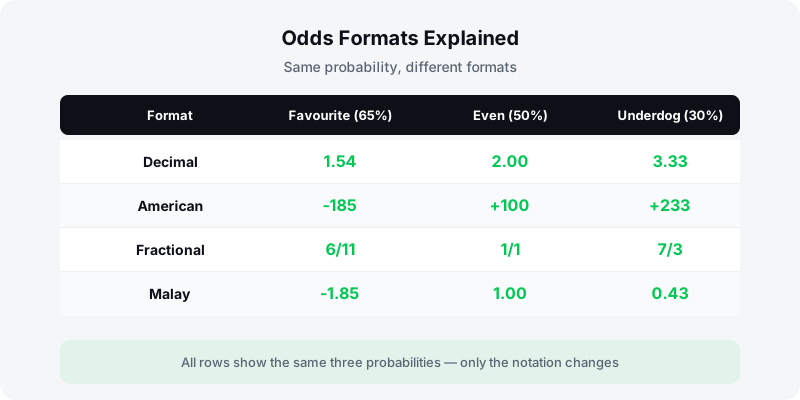
Odds formats are one of those things that cause unnecessary confusion — especially if you're moving between markets, sportsbooks, or countries. There's no mathematical difference between them. They're all expressing the same thing: the price of a bet. The differences are purely regional convention.
Once you understand all seven formats, you'll never be thrown off by an unfamiliar display again.
Why Different Formats Exist
Odds formats evolved in geographic isolation. British bookmakers used fractions long before the internet connected global markets. American sportsbooks developed their own system around the concept of a $100 base unit. Asian markets — Hong Kong, Malaysia, Indonesia — developed yet more formats suited to their own trading conventions and bettor psychology.
Today, most online bookmakers let you switch formats in account settings. But understanding them all makes you a faster, more confident bettor when lines move and context shifts.
The Same Bet, Seven Ways
We'll use a single example throughout: an event where the true probability is 60%. A fair price with zero vig would be:
You bet $100. If you win, you receive your $100 stake back plus $66.67 profit.
Here's how every format expresses that:
1. Decimal Odds — 1.667
The most intuitive format. The number represents your total return per unit staked, including your stake back.
Return = Stake x Decimal Odds
$100 x 1.667 = $166.70 ($66.70 profit)
Probability: 1 / 1.667 = 60%
Decimal is the global standard for exchanges and most European books. If you're unsure which format to use, use decimal — it's the clearest.
2. Fractional Odds — 2/3
The traditional British format. Expresses profit relative to stake.
2/3 means: win $2 for every $3 staked
$100 stake -> $66.67 profit
Probability: denominator / (numerator + denominator) = 3 / (2 + 3) = 60%
Fractions are intuitive for simple cases but become unwieldy with non-round numbers (e.g., 11/8, 4/11). They're mostly encountered on horse racing.
3. American (Moneyline) Odds — -150
American odds use a $100 reference unit with a sign indicating direction:
- Negative = how much you must stake to win $100 profit
- Positive = how much profit you win from a $100 stake
At 60% probability, you're the favourite, so odds are negative:
-150 means: stake $150 to win $100 profit
Implied probability: 150 / (150 + 100) = 60%
If the probability were below 50%, you'd see a positive number (e.g., +133 for a ~43% chance).
4. Malay Odds — -1.50
Malay odds are where things get interesting — and where most Western bettors go wrong. The format has two modes depending on whether the bet is a favourite or underdog:
Positive Malay (underdog, implied prob < 50%):
- The number represents profit per unit staked
- Positive Malay 0.80 -> win 0.80 for every 1.00 staked
Negative Malay (favourite, implied prob > 50%):
- The number represents stake needed per unit of profit
- Negative Malay -1.50 -> stake 1.50 to win 1.00
Our 60% example:
Malay: -1.50
Stake 1.50 units -> win 1.00 unit profit
The crossover point is exactly 50%. An even-money bet is 1.00 in Malay odds (profit equals stake). Understanding this positive/negative flip is the key to reading Malay odds fluently.
5. Hong Kong Odds — 0.667
Simpler than Malay. Hong Kong odds always express profit per unit staked — no sign flip, no mode switching.
HK 0.667: stake 1 unit, win 0.667 profit
$100 stake -> $66.70 profit
Probability: 1 / (HK_odds + 1) = 1 / 1.667 = 60%
Hong Kong odds are always positive. Converting from decimal: HK = Decimal - 1. Clean and simple.
6. Indonesian Odds — -1.50
Indonesian odds look like a hybrid of American and Malay. They also have a sign flip at the 50% mark:
Positive Indonesian (underdog):
- Profit per unit staked (same as Hong Kong)
- Positive Indo 1.667 -> win 1.667 for every 1 staked
Negative Indonesian (favourite):
- Units you must stake to win 1 unit profit
- Negative Indo -1.50 -> stake 1.50 to win 1.00
The key difference from Malay: the scale. Indonesian odds multiply everything by a factor that produces larger numbers than Malay, while Malay odds tend to sit between -1 and +1. In practice, for the same event, Indo positive will always equal the decimal odds minus 1 (when the underdog), and the negative side will mirror Malay.
7. Implied Probability — 60%
Not technically an odds format, but increasingly displayed on exchanges and modern books. It cuts straight to the point: what probability does this price imply?
60% = 1 / 1.667 decimal
Malay Odds: The Deep Dive
Malay odds deserve extra attention because they're widely used in Southeast Asian betting markets and genuinely confusing until they click.
The key rule: positive Malay = underdog, negative Malay = favourite.
| Malay | Meaning | Decimal Equivalent |
|---|---|---|
| 0.50 | Win 0.50 per 1 staked | 1.50 |
| 1.00 | Win 1.00 per 1 staked (even money) | 2.00 |
| -1.50 | Stake 1.50 to win 1.00 | 1.667 |
| -2.00 | Stake 2.00 to win 1.00 | 1.50 |
The critical thing to internalize: when Malay goes negative, bigger absolute values mean bigger favourites at shorter prices. Malay -3.00 is a much shorter price than Malay -1.20.
Converting Malay to decimal:
- Positive Malay:
Decimal = Malay + 1 - Negative Malay:
Decimal = (1 / |Malay|) + 1
Common Conversion Mistakes
1. Treating negative Malay like American odds. American -150 and Malay -1.50 are not the same. American -150 means stake 150 to win 100. Malay -1.50 means stake 1.50 to win 1.00. They describe the same bet, but the units differ.
2. Forgetting stake in decimal returns. Decimal 1.667 returns $166.70 on a $100 bet — but only $66.70 of that is profit. Easy mistake when comparing to fractional where the number already means profit.
3. Flipping the HK/Malay difference. Hong Kong odds are always positive and always mean profit per unit. Malay goes negative for favourites. Don't mix them up when reading Asian handicap boards. Convert any format instantly with our free Odds Converter.
Human-picked, AI-operated. A human chose this play; AI wrote, published and settles it.